
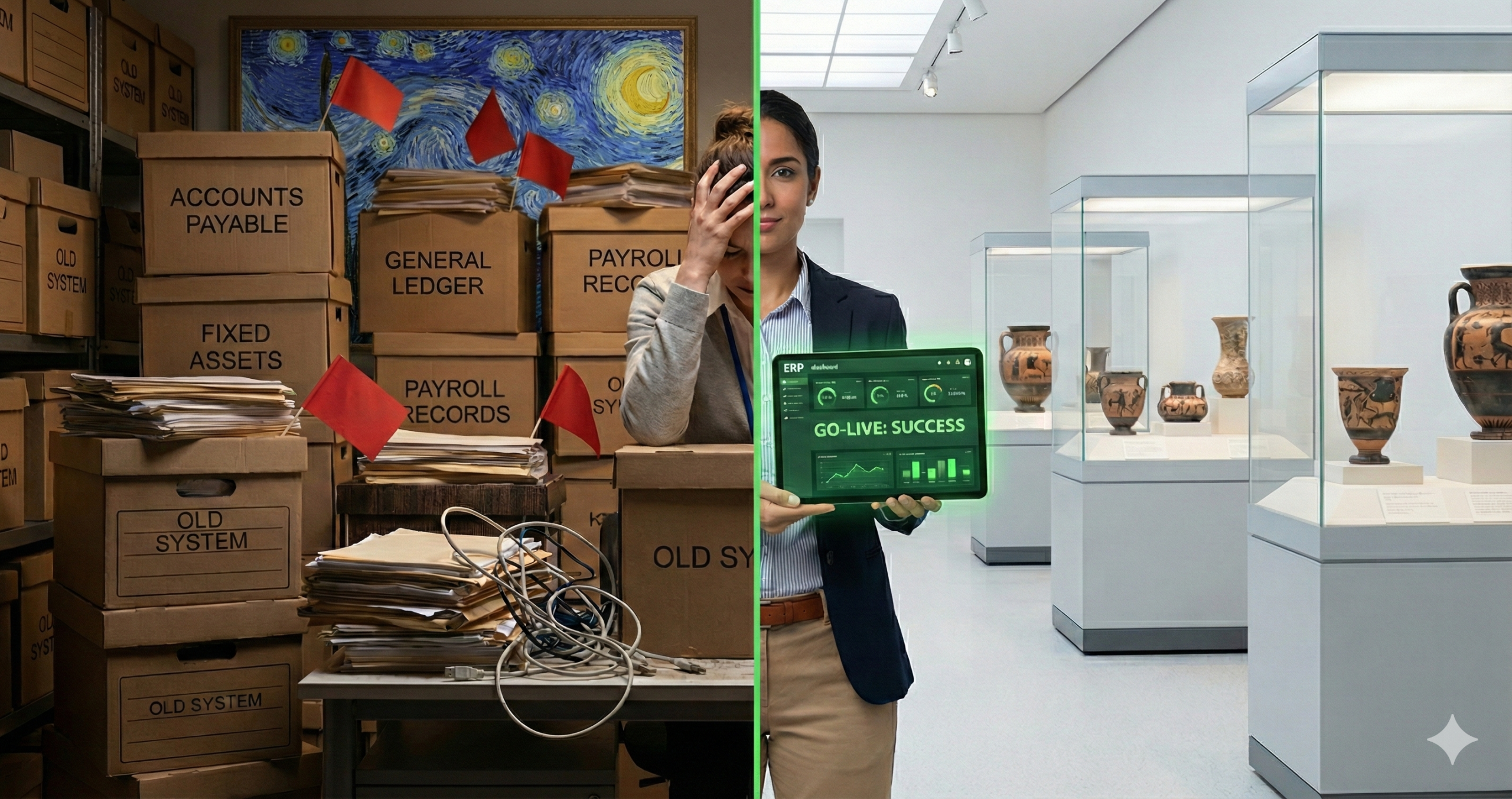
This project should have been harder than it was.
An accounting leader at a major NYC museum came to us with an ERP migration that had every red flag in the book:
- Multi-Entity Nonprofit organization
- Migrating from a 20-year-old Peoplesoft instance (out of support)
- Fund accounting requirements with 200+ funds
- Allocations with complex rules
- Finance processes focused on tracking costs and managing vendors and fixed assets
If you’ve been around enterprise software implementations long enough, you’ve seen this setup. These projects typically drag on for 18+ months, blow through change orders, and sometimes get cancelled before they ever go live.
This one finished in 6 months. On time. Under budget. They’re still our customer 6 years later.
Here’s what made the difference—and it had nothing to do with the technology.
The museum had Sara
Sara was an accounting leader who’d been with the organization for 20 years. This was her third ERP migration. She understood how everything worked—not just her department, but the entire financial operation across all 200+ funds.
She had authority. The CFO backed her completely. When trade-offs needed to happen, she made the call. Finance, IT, and operations all had seats at the table, but Sara drove decisions.
She thought strategically about technology. The museum had already invested heavily in Salesforce CRM for their Development team (remember, nonprofits rely on donor relationships). Sara chose Certinia because it integrated natively with their existing Salesforce investment and had the technical horsepower to handle their fund accounting requirements. She wasn’t starting from scratch—she was building on what they already had.
She had scope discipline. FP&A capabilities had started in scope, but Sara said no. When Teamwork integration threatened the timeline in October, Sara made the call: Phase 2. The system would go live with core capabilities on January 1st as planned.
She managed complexity without panic. Through October and November, we worked through Chargent integration issues, OCR vendor selection, and banking format requirements. Sara stayed focused: core capabilities first, enhancements in Phase 2. When we discovered Certinia’s allocations engine didn’t handle all of her scenarios, she didn’t freeze. She worked with our team to scope custom development. Not ideal, but manageable because she could make decisions quickly.
She had patience with stakeholders. Getting IT aligned took time. We iterated on requirements for Vendor Invoice Approvals. There were questions, concerns, and different perspectives. But Sara worked through them all methodically. When it came down to execution, there were no blow-ups or roadblocks.
The pattern of failure
In contrast, over 15 years of ERP implementations, I’ve watched a pattern of failure also play out. The organizations that struggle all share the same characteristics:
Committee-based governance. A steering committee of 4-6 stakeholders share responsibility for decision-making. Every department has veto power. There’s at least one stakeholder that believes every legacy workflow must be preserved, and their resolve breaks down even the executive sponsor’s best intentions.
No single throat to choke. When decisions need to happen, there’s no clear owner. Decisions are delayed. Acceptance is a process rather than a milestone.
Unicorn syndrome. “We’re different. Our processes are unique. We need extensive customization.” Six months into discovery, you’re no closer to go-live than day one.
I’ve seen projects at month 18 that were no closer to being live than they were at month 6. The technology wasn’t the problem. The governance was.
The lesson
Leadership and governance matter infinitely more than which vendor you pick.
The museum project succeeded because Sara had three things:
- Deep institutional knowledge (20 years, third ERP migration)
- Executive backing (CFO’s complete trust)
- Decision-making authority (not consensus-seeking)
Technology selection mattered—but it was secondary to getting the governance right.
Before you start your ERP implementation, answer these five questions first:
- Who owns this end-to-end? Not “who’s on the steering committee” but who has final accountability when trade-offs need to happen.
- Do they have deep institutional knowledge? Have they been with your organization long enough to understand how all the pieces fit together?
- Do they have executive backing? Can they drive decisions up and down the organizational chain, or will every call require escalation?
- Can they say no to scope creep? Will they resist the urge to customize everything and keep you focused on getting live?
- Have they done this before? Third time through an ERP migration beats first time, every time.
If you can’t answer these questions clearly, stop. Fix your governance before you sign a vendor contract.
The technology will work if the leadership is right. The technology won’t make up the difference if the governance is wrong.
It’s that simple.
About Icon Cloud Consulting’s Certinia PSA services
Icon Cloud Consulting is a Tier 1 Certinia Systems Integrator specializing in professional services automation implementations.
With over 300 completed Certinia projects, our team brings deep expertise in PSA consulting services, resource management, project financials, time tracking, billing automation, and revenue recognition.
Our Icon1 rapid deployment solution delivers full PSA capability, including project management, resource planning, timecard management, and financial controls in two weeks. Unlike traditional PSA implementation methodologies that extend timelines through excessive discovery and configuration debates, Icon1 leverages proven best practices to get your team productive immediately.
Contact Icon Cloud Consulting to learn how Icon1 can deliver production-ready Certinia PSA in two weeks. Download the Icon1 Data Sheet for complete pricing and feature details.